

Network security compliance is no longer a concern reserved for large enterprises with legal teams and dedicated IT security departments. GDPR has applied to every organization processing personal data of EU residents since 2018, regardless of company size. NIS2 — the EU’s updated cybersecurity directive, which took effect in October 2024 — extends mandatory cybersecurity obligations to a significantly broader range of organizations than its predecessor. For SMEs (Small and Medium-sized Enterprises) operating in Europe or serving European customers, understanding what these frameworks require technically is increasingly important.
This article is not legal advice. It is a practical overview of the technical security controls that GDPR and NIS2 call for, and an honest assessment of which of those controls a network security appliance can help satisfy — and which it cannot.
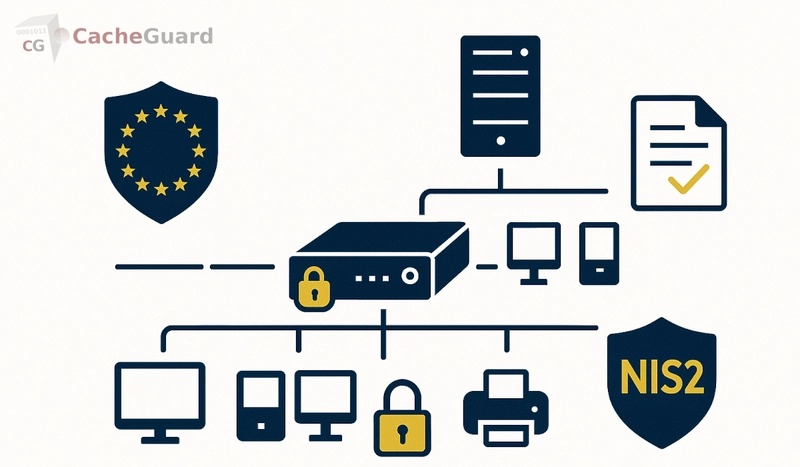
GDPR: What It Requires for Network Security Compliance
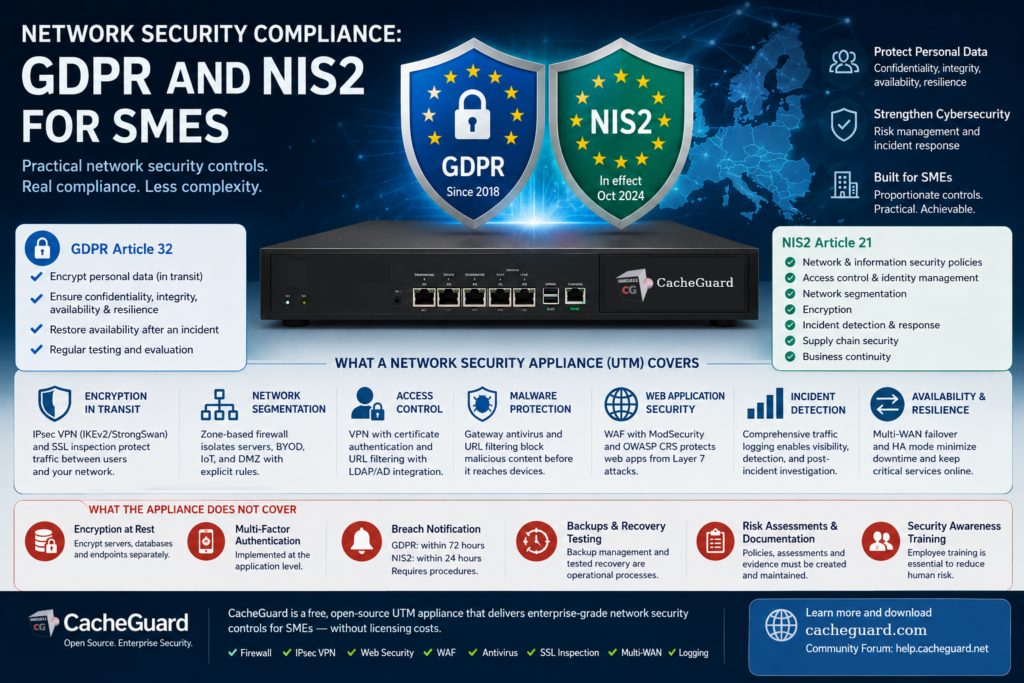
The General Data Protection Regulation (GDPR) does not specify products or technologies. Instead, Article 32 requires organizations to implement “appropriate technical and organizational measures” to ensure a level of security appropriate to the risk. It identifies four specific technical capabilities as examples of what “appropriate” looks like:
- Pseudonymization and encryption of personal data — protecting data in transit and at rest
- Ensuring ongoing confidentiality, integrity, availability, and resilience of processing systems
- Ability to restore availability and access to personal data in the event of an incident
- Regular testing, assessing, and evaluating the effectiveness of technical measures
The principle-based approach means that what counts as “appropriate” depends on the nature of the data, the risks involved, and the size and resources of the organization. An SME accounting firm processing client financial data has different obligations than a large healthcare provider — but both have obligations.
For network security specifically, GDPR compliance implies protecting the network perimeter so that personal data in transit is not accessible to unauthorized parties, ensuring that systems processing personal data are protected from unauthorized access, and logging access to systems holding personal data so that breaches can be detected and investigated.
NIS2: Network Security Compliance for a Broader Range of Organizations
The NIS2 Directive (Directive EU 2022/2555) replaced the original NIS Directive in October 2024. It significantly expands the scope of mandatory cybersecurity obligations across eighteen critical sectors including energy, transport, health, digital infrastructure, ICT service management, public administration, and others.
Does NIS2 apply to your SME?
NIS2 primarily applies to medium and large organizations — those with 50 or more employees or an annual turnover of €10 million or more — operating in covered sectors. Most micro and small enterprises are exempt from NIS2’s direct obligations. However there are important exceptions: SMEs that are sole providers of a service essential to a covered sector, or that would cause significant disruption to public safety if their service were interrupted, may still fall within scope. Additionally, if your SME is a supplier to a larger organization that is subject to NIS2, you may face indirect compliance pressure through supply chain security requirements imposed by your customer.
The European Commission proposed amendments in January 2026 specifically to simplify compliance for the 6,200 micro and small enterprises that do fall within scope — an acknowledgment that the original directive’s requirements were disproportionate for smaller organizations.
What NIS2 requires technically
For organizations that are in scope, Article 21 of NIS2 specifies ten mandatory cybersecurity measures. The ones most directly relevant to network security compliance are:
- Network security and information system security policies — documented policies covering risk management
- Access control and identity management — controlling who can access which systems
- Network segmentation — isolating different parts of the network to contain the impact of breaches
- Encryption — of data in transit and at rest where appropriate
- Incident detection and response — ability to detect security incidents and respond to them
- Supply chain security — assessing the security of suppliers and service providers
- Business continuity — backup management and disaster recovery
What a Network Security Appliance Covers for Compliance
A complete network security appliance — a UTM (Unified Threat Management) device sitting at your internet gateway — addresses several of the technical controls that both GDPR and NIS2 require. Here is an honest mapping of which requirements it helps satisfy and how.
| Compliance requirement | How a UTM helps |
|---|---|
| Encryption in transit | IPsec VPN with IKEv2 based on StrongSwan encrypts all traffic between remote workers and the office network. SSL inspection decrypts and re-encrypts HTTPS traffic at the gateway. |
| Network segmentation | Zone-based firewall architecture isolates different network segments — servers, BYOD devices, IoT, DMZ — with explicit rules controlling traffic between zones. |
| Access control | VPN with certificate-based authentication controls who can access the internal network remotely. URL filtering with LDAP/AD integration enforces per-user access policies. |
| Malware protection | Gateway antivirus scans web traffic before it reaches any device. URL filtering blocks known malicious domains and phishing sites. |
| Web application security | Built-in WAF powered by ModSecurity and the OWASP Core Rule Set protects web-facing applications from injection attacks and other Layer 7 threats. |
| Incident detection | Traffic logging at the gateway provides visibility into all network connections, enabling detection of unusual patterns and post-incident investigation. |
| Availability and resilience | Multi-WAN failover with automatic switchover, and high-availability mode with two appliances, reduces downtime risk for critical network services. |
What Network Security Compliance Also Requires Beyond the Appliance
Being honest about the limits of technical tools is important for genuine compliance. A network security appliance does not cover every obligation that GDPR and NIS2 impose. The following controls are required and must be addressed separately.
- Encryption at rest. A gateway appliance encrypts traffic in transit — it does not encrypt data stored on your servers, databases, or endpoints. Full-disk encryption and database encryption are separate controls.
- Multi-factor authentication (MFA). NIS2 explicitly references MFA as a required control. This is implemented at the application level — your email platform, cloud applications, and admin interfaces — not at the network gateway.
- Data breach notification. GDPR requires notification to the supervisory authority within 72 hours of discovering a breach. NIS2 requires incident reporting within 24 hours. Neither is a technical network control — both require documented organizational procedures.
- Data backups and recovery testing. Business continuity requirements in NIS2 specifically include backup management and tested recovery procedures. These are operational processes, not gateway features.
- Risk assessments and documentation. Both frameworks require documented risk assessments, security policies, and evidence of compliance. A network appliance generates logs — but the policies, assessments, and documentation must be produced and maintained by the organization.
- Employee security awareness training. Human error remains the leading cause of security incidents. Both frameworks implicitly require that staff understand security policies — a training and organizational requirement, not a technical one.
Network Security Compliance: The Practical Starting Point for SMEs
For an SME beginning its network security compliance journey, the most practical starting point is implementing the technical controls that are both clearly required and clearly achievable without specialized expertise. Network segmentation, encrypted remote access, gateway malware protection, and web application security are controls that a network appliance delivers without requiring a security team.
These controls serve two purposes simultaneously: they represent genuine security improvements that reduce actual risk, and they provide documented technical evidence of compliance effort — relevant both for GDPR’s “appropriate measures” standard and for any NIS2 obligation that applies to your organization.
A network security appliance is not a compliance solution in the sense that deploying it makes you compliant. It is one component of a compliance posture — the technical network security layer that both frameworks call for as a foundation, on top of which organizational policies, MFA, backup procedures, and documentation must be built.
CacheGuard is a free, open-source network security appliance that implements all of the gateway-level technical controls described in this article: zone-based firewall, IPsec VPN with IKEv2 based on StrongSwan, URL filtering with LDAP/AD integration, gateway antivirus, SSL inspection, WAF, multi-WAN failover, and traffic logging — as part of a single integrated UTM appliance. For SMEs that need to demonstrate technical security controls as part of their GDPR or NIS2 compliance posture, it provides the network security foundation without licensing cost.
It installs from a single ISO image on any standard x86 machine or virtual machine. You can download CacheGuard for free from the official website.
For organizations that have BYOD environments or that need to address the limitations of endpoint-only security, the same appliance addresses those concerns alongside the compliance requirements — a single deployment that serves multiple security objectives simultaneously.
This article provides general information about network security compliance requirements. It is not legal advice. Consult a qualified legal or compliance professional to assess your specific obligations under GDPR, NIS2, or any other applicable regulation.
Questions about deploying CacheGuard? Visit the community forum at help.cacheguard.net or browse the full documentation at CacheGuard Documentation.
