

If you are evaluating open-source firewall alternatives — whether you are setting up network security for the first time, replacing an existing solution that no longer meets your needs, or simply looking for a more cost-effective option — this guide gives you a clear, honest overview of the main open-source alternatives available today and helps you choose the right one for your organization.
We focus primarily on open-source firewall alternatives, and include a dedicated section on commercial solutions for organizations that need to consider them.
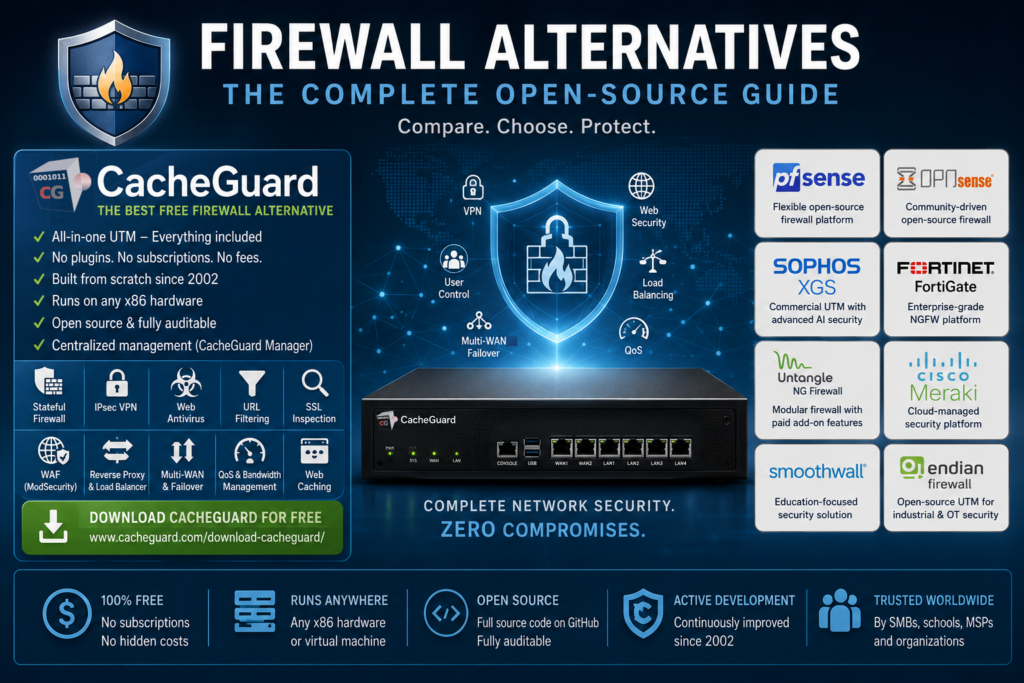
What to Look for in Firewall Alternatives
Not all firewall alternatives are equal. Before comparing specific products, it is worth understanding what criteria actually matter when choosing a network security solution:
All-in-one vs modular. Some firewall alternatives are pure firewalls that require additional plugins or packages to add features like VPN, web antivirus, URL filtering or WAF. Others are integrated UTM appliances that include everything out of the box. For organizations without dedicated IT teams, an integrated solution is almost always the right choice.
Hardware flexibility. Some solutions require proprietary hardware. Others run on any standard x86 machine or virtual machine. Hardware flexibility directly affects your total cost of ownership.
Licensing and cost. Commercial firewall alternatives typically require annual subscription fees to access security features. Open-source alternatives are free but vary significantly in feature completeness.
Ease of deployment and management. A firewall alternative that takes days to configure correctly is not practical for most organizations. Deployment time and management complexity are critical factors.
Active development. Network security threats evolve constantly. A firewall alternative that is not actively maintained quickly becomes a liability.
Open-Source Firewall Alternatives Compared
CacheGuard — The Best Free Firewall Alternatives Solution
CacheGuard is a free, open-source UTM appliance that has been in development since 2002 — representing over 5,000 man days of research and development. It is not an application running on top of an existing operating system — it IS the operating system, a fully custom network appliance oriented Linux distribution built from scratch.
CacheGuard is the most complete free firewall alternative available today. Everything is included out of the box with no plugins, no subscription fees and no proprietary hardware required:
- Stateful firewall with fine-grained traffic control
- IPsec VPN for secure remote access and site-to-site connectivity
- Gateway-level web antivirus powered by ClamAV
- Filtering web proxy with URL filtering — with LDAP/AD integration
- SSL inspection (called SSL mediation in CacheGuard) for encrypted traffic scanning and HTTPS caching
- Web Application Firewall powered by ModSecurity and OWASP Core Rule Set
- Reverse proxy and load balancer with high availability mode
- Multi-WAN support with automatic failover
- QoS and bandwidth management
- Web caching to reduce bandwidth usage
- Integrated mini PKI for internal certificate management
- Centralized management via CacheGuard Manager for multi-site deployments
Best for: Startups, small and medium businesses, schools, MSPs and any organization that needs a complete UTM without enterprise costs.
👉 Download CacheGuard for free
pfSense — A Flexible Open-Source Option Among Firewall Alternatives
pfSense is a powerful open-source firewall and routing platform built on FreeBSD. It is highly configurable and has a large community, making it a popular choice for experienced network administrators who need granular control over every aspect of their network.
However pfSense requires significant expertise to deploy correctly and relies on third-party packages to reach full UTM feature parity. For organizations without dedicated networking specialists, the complexity can become a barrier.
Best for: Experienced IT teams that need deep configuration control and advanced routing capabilities.
👉 Read our full comparison: pfSense vs CacheGuard 👉 Ready to switch? pfSense Alternative: Why CacheGuard Is a Smarter Choice
OPNsense — A Community-Driven Option Among Firewall Alternatives
OPNsense is a FreeBSD-based open-source firewall with a strong focus on usability and regular releases. It offers a modern web interface and an active plugin ecosystem. Like pfSense, it requires plugins to reach full UTM feature parity and is best suited for users with solid networking knowledge.
Best for: Organizations that want a well-supported open-source firewall with a modern interface and are comfortable managing plugins.
👉 Read our full comparison: OPNsense Alternative: Why CacheGuard Is the Easier Choice
Untangle NG Firewall — A Modular Option Among Firewall Alternatives
Untangle NG Firewall takes a modular approach — the core firewall is free but most security features require paid add-on subscriptions. This makes it flexible but potentially expensive once you add the features you actually need. It is popular in education environments.
Best for: Organizations that prefer a modular, pay-per-feature model and are comfortable managing subscription add-ons.
👉 Read our full comparison: Untangle Alternative: Why CacheGuard Is a Smarter Choice
Smoothwall — An Education-Focused Option Among Firewall Alternatives
Smoothwall comes in two versions: Smoothwall Express (free, open source, last updated in 2014) and Smoothwall UTM (commercial, education-focused subscription product). The free version is largely outdated and the commercial version is primarily designed for schools.
Best for: Educational institutions, particularly those in the US that benefit from Smoothwall’s E-Rate eligibility and education-specific content filtering.
👉 Read our full comparison: Smoothwall Alternative: Why CacheGuard Is a Better Choice
Endian Firewall — An Open-Source UTM Among Firewall Alternatives
Endian Firewall is a fork of IPCop (itself a fork of SmoothWall) available as a free community edition and a commercial product. The community edition lacks WAF and reverse proxy capabilities. Endian has increasingly focused on industrial OT security, making its commercial product less relevant for general SMB use.
Best for: Industrial and OT environments where Endian’s specific IT/OT security focus adds genuine value.
👉 Read our full comparison: Endian Firewall Alternative: Choose CacheGuard
Open-Source Firewall Alternatives: Full Feature Comparison
| Feature | CacheGuard | pfSense | OPNsense | Untangle | Smoothwall | Endian |
|---|---|---|---|---|---|---|
| Firewall | ✅ | ✅ | ✅ | ✅ Core only | ✅ | ✅ |
| IPsec VPN | ✅ | ✅ | ✅ | ✅ | ✅ | ✅ |
| SSL VPN | ❌ | ✅ | ✅ | ⚠️ Paid | ✅ | ✅ |
| Web antivirus | ✅ Built-in | ⚠️ Package | ⚠️ Plugin | ⚠️ Paid | ✅ | ✅ |
| URL filtering | ✅ LDAP/AD | ⚠️ Package | ⚠️ Plugin | ⚠️ Paid | ✅ | ⚠️ Basic |
| SSL inspection | ✅ Built-in | ⚠️ Package | ⚠️ Plugin | ⚠️ Paid | ✅ UTM only | ⚠️ Limited |
| WAF | ✅ Built-in | ⚠️ Package | ❌ | ❌ | ❌ | ❌ |
| Reverse proxy | ✅ Built-in | ⚠️ Package | ⚠️ Plugin | ❌ | ❌ | ❌ |
| Load balancer | ✅ Built-in | ⚠️ Package | ⚠️ Plugin | ❌ | ❌ | ✅ Basic |
| Web caching | ✅ Built-in | ⚠️ Package | ⚠️ Plugin | ⚠️ Paid | ✅ | ✅ |
| Multi-WAN / QoS | ✅ | ✅ | ✅ | ⚠️ Paid | ✅ | ✅ |
| Centralized mgmt | ✅ Free | ❌ | ❌ | ✅ Paid | ✅ UTM only | ❌ |
| Mini PKI | ✅ | ❌ | ❌ | ❌ | ❌ | ❌ |
| Hardware flexibility | ✅ Any x86 | ✅ Any x86 | ✅ Any x86 | ✅ Any x86 | ✅ Any x86 | ✅ Any x86 |
| Open source | ✅ Full | ✅ Full | ✅ Full | ❌ Core only | ✅ Express only | ✅ Community |
| Actively maintained | ✅ Since 2002 | ✅ | ✅ | ✅ | ⚠️ Express outdated | ✅ |
| Cost | Free | Free | Free | Free + paid add-ons | Free / Subscription | Free / Subscription |
Non Open-Source Firewall Alternatives
If your organization has a larger security budget or specific enterprise requirements, the following commercial solutions are worth considering. They are not open source and require proprietary hardware or subscription licensing — but they offer advanced features that go beyond what open-source alternatives currently provide.
Sophos XGS
Sophos XGS is a commercial UTM appliance that takes an all-in-one approach similar to CacheGuard — but at a significant cost. It requires proprietary hardware or a paid virtual license and annual subscription fees. Its advanced features include deep learning threat detection, cloud sandboxing and Security Heartbeat endpoint integration.
Best for: Organizations with significant security budgets that need advanced AI-driven threat detection and vendor-backed support.
👉 Read our full comparison: Sophos Alternative: Why CacheGuard Is a Smarter Choice
Fortinet FortiGate
Fortinet FortiGate is one of the most widely deployed enterprise next-generation firewalls in the world. It delivers exceptional performance and deep security capabilities — but at enterprise prices. Annual subscription fees for security features, proprietary hardware requirements and a steep learning curve make it impractical for most startups and small businesses.
Best for: Large enterprises with complex, high-throughput network environments and dedicated security teams.
👉 Read our full comparison: Fortinet Alternative: Why CacheGuard Is a Smarter Choice
Cisco Meraki
Cisco Meraki is a cloud-managed networking and security platform popular in enterprise and education environments. Its zero-touch provisioning and centralized cloud dashboard make it easy to manage distributed networks — but at a significant cost. Devices stop functioning when licenses expire, making it a high-dependency and high-cost option.
Best for: Large enterprises with distributed networks and significant IT budgets that value cloud-managed zero-touch provisioning.
👉 Read our full comparison: Cisco Meraki Alternative: Why CacheGuard Costs Less
Which Firewall Alternatives Are Right for You?
| Your situation | Recommended solution |
|---|---|
| Startup or SMB, first security setup, limited IT resources | CacheGuard |
| Need a complete UTM, zero budget for licensing | CacheGuard |
| Experienced admin, need deep routing control | pfSense or OPNsense |
| Modular approach, pay only for what you need | Untangle |
| Education institution, need E-Rate eligibility | Smoothwall UTM |
| Industrial or OT environment | Endian UTM |
| Need advanced AI threat detection, have budget | Sophos XGS |
| Large enterprise, high throughput, compliance | FortiGate |
| Distributed enterprise, cloud-managed | Cisco Meraki |
Why CacheGuard Stands Out Among Firewall Alternatives
Among all the open-source firewall alternatives listed in this guide, CacheGuard is unique in several ways:
It is the only free solution that includes everything out of the box. pfSense and OPNsense are free but require packages and plugins to reach UTM feature parity. CacheGuard includes firewall, VPN, web antivirus, URL filtering, SSL inspection, WAF, reverse proxy, load balancer, QoS and web caching — all working together from day one.
It is built from scratch. Unlike pfSense, OPNsense and Endian which are all derived from existing distributions, CacheGuard has been built from scratch since 2002 as a dedicated network appliance OS. This means no inherited legacy code, no upstream compatibility constraints and a codebase designed entirely for security and performance.
It runs on any hardware. No proprietary hardware, no paid virtual licenses. Install it on any x86 machine or VM you already own and it works immediately.
It is fully open source. The complete source code is available on GitHub — over 5,000 man days of research and development, fully auditable by anyone.
Conclusion
Choosing among the available firewall alternatives comes down to three questions: how much do you want to spend, how much complexity can your team manage, and how complete does your security stack need to be from day one?
For startups, small businesses and growing organizations that need comprehensive network security without enterprise costs or complexity, CacheGuard is the most compelling free open-source firewall alternative available today.
Download CacheGuard for free and have your network fully protected in under an hour.
Questions about deploying CacheGuard? Visit the community forum at help.cacheguard.net or browse the full documentation at CacheGuard Documentation.
