
pfSense Alternative: Why CacheGuard Is a Smarter Choice for Small Businesses
You have decided to move away from pfSense and are actively looking for a pfSense alternative that is easier to deploy, requires less ongoing maintenance, and delivers a complete security stack out of the box without plugins or specialist knowledge. You are in the right place.
This article is not a neutral comparison between pfSense and CacheGuard — if that is what you are looking for, read our dedicated pfSense vs CacheGuard article. This article is specifically for organizations that have already decided pfSense is not the right fit and are ready to switch to something simpler, faster and more integrated.
CacheGuard is a free, open-source UTM appliance that replaces pfSense with a complete, production-ready security gateway — firewall, IPsec VPN, web antivirus, URL filtering, SSL inspection, WAF, reverse proxy, load balancer and QoS — all working together out of the box, in under an hour, on hardware you already own.
Why Organizations Switch Away from pfSense
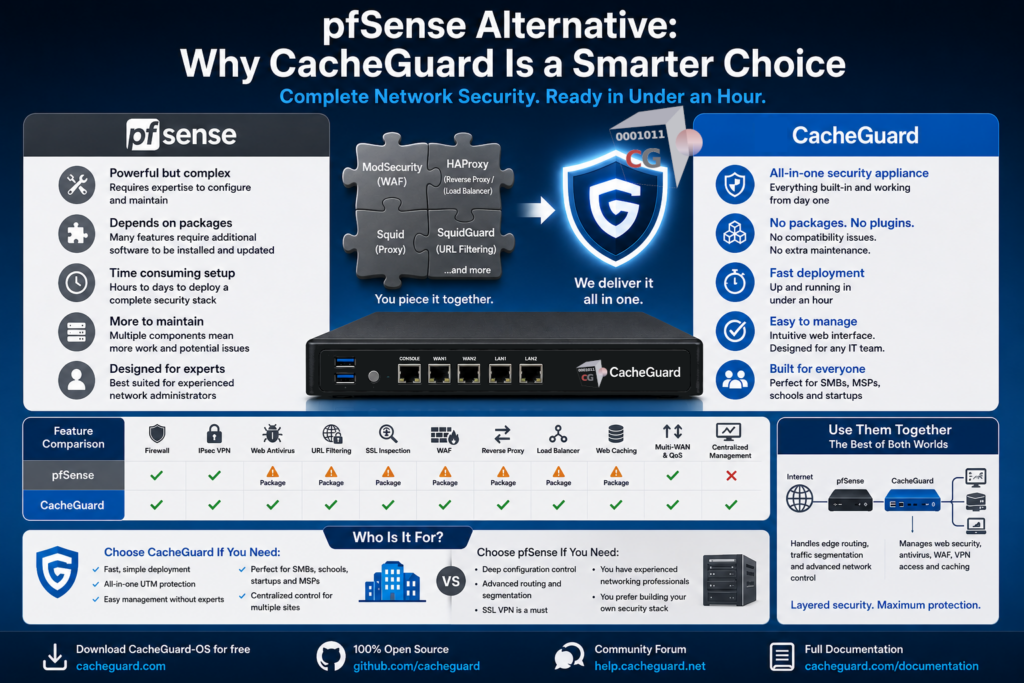
pfSense is built on FreeBSD and designed to give experienced administrators granular control over every aspect of their network. That level of control is genuinely valuable in complex enterprise environments. But it comes with trade-offs that many smaller organizations find difficult to manage.
You need expertise to unlock its full potential. pfSense assumes a strong foundation in networking and BSD system administration. Getting features like web antivirus, content filtering, a WAF or SSL inspection working requires installing and configuring third-party packages — each with its own learning curve.
Package dependency creates maintenance overhead. A fully featured pfSense setup relies on packages like Squid, Snort, ClamAV and others. Keeping these packages updated, compatible with each other and running correctly over time takes ongoing effort that many small teams simply cannot afford.
Setup time can stretch from hours to days. For a startup that needs network security in place quickly, the time required to deploy pfSense to a production-ready standard with all security features active is a real obstacle.
These are the most common reasons organizations start looking for a pfSense alternative — not because pfSense is a bad product, but because it is not the right tool for every situation.
CacheGuard as a pfSense Alternative: A Different Philosophy
CacheGuard approaches network security from a completely different angle. Rather than providing a flexible platform you assemble piece by piece, it delivers a fully integrated security appliance in a single ISO — ready to protect your network in under an hour.
A complete pfSense alternative out of the box
Everything CacheGuard offers is built in and works together from day one. There are no packages to install, no compatibility issues to debug, no third-party components to maintain separately. The complete feature set includes:
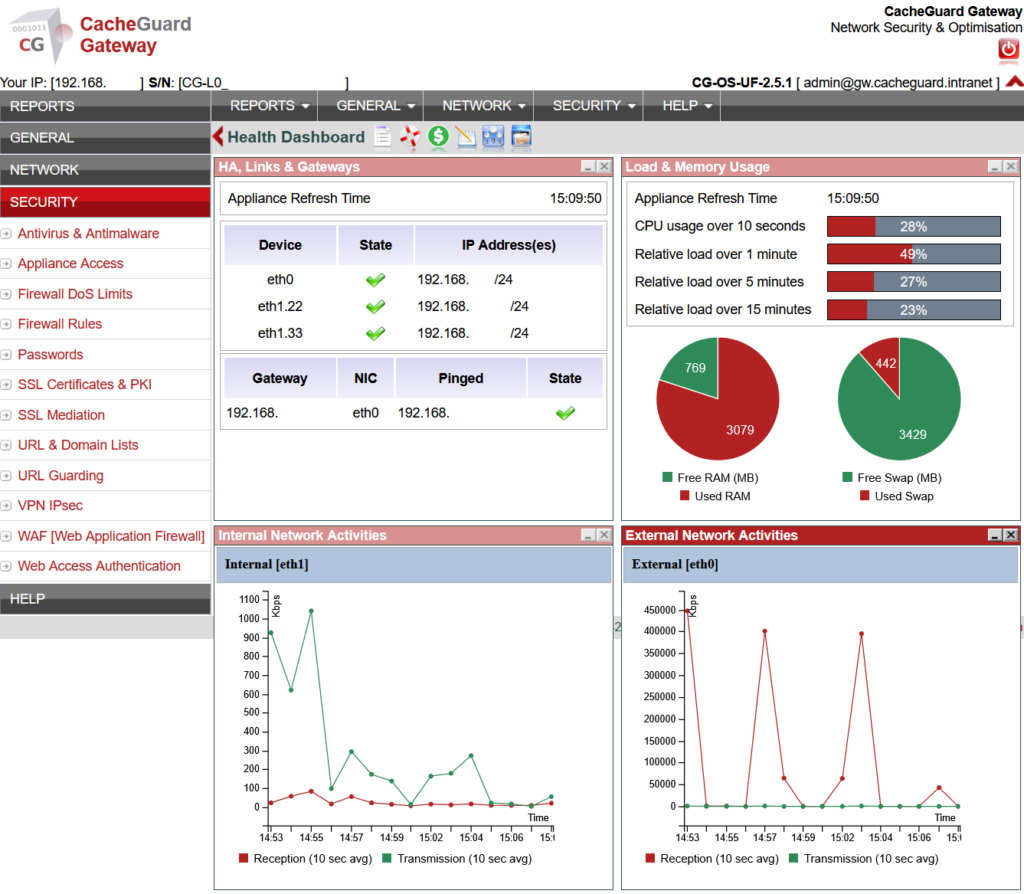
- Stateful firewall with granular traffic control rules
- IPsec VPN for secure remote access and site-to-site tunnels
- Gateway-level web antivirus powered by ClamAV
- URL filtering to block malicious and unwanted websites
- SSL inspection to detect threats hidden in encrypted traffic
- Web Application Firewall to protect your web applications
- Reverse proxy and application load balancer
- Multi-WAN support with automatic failover and load balancing
- QoS and traffic shaping to prioritize critical applications
- Web caching to reduce bandwidth consumption
- Centralized management via CacheGuard Manager for multi-site deployments
Not an app — an operating system
One of the most important things to understand about CacheGuard as a pfSense alternative is that it is not software you install on top of an existing OS. CacheGuard-OS is itself the operating system — a fully custom, network appliance oriented Linux distribution built entirely from scratch over more than 20 years, now completely open source on GitHub.
This means CacheGuard carries none of the bloat or attack surface of a general purpose operating system. Every component has been selected and integrated deliberately, with security and performance as the primary design criteria.
Designed for teams without network specialists
Where pfSense is designed for expert administrators, CacheGuard is designed to be managed by anyone with basic networking knowledge. The web interface is intuitive and well documented, and the system handles the complexity of integrating its components so you do not have to.
pfSense Alternative Feature Comparison
| Feature | pfSense | CacheGuard |
|---|---|---|
| Firewall | ✅ Advanced, highly configurable | ✅ Standard, suitable for most deployments |
| IPsec VPN | ✅ | ✅ |
| SSL VPN | ✅ | ❌ IPsec only |
| Web antivirus | ⚠️ Package required | ✅ Built-in |
| URL filtering | ⚠️ Package required | ✅ Built-in, LDAP/AD |
| SSL inspection | ⚠️ Package required | ✅ Built-in |
| WAF | ⚠️ Package required | ✅ Built-in |
| Reverse proxy | ⚠️ Package required | ✅ Built-in |
| Load balancer | ⚠️ Package required | ✅ Built-in |
| Web caching | ⚠️ Package required | ✅ Built-in |
| Multi-WAN and QoS | ✅ | ✅ |
| Centralized management | ❌ | ✅ CacheGuard Manager |
| Setup time | Several hours to days | Under an hour |
| Base OS | FreeBSD | Custom Linux from scratch |
| Cost | Free | Free |
| Open source | ✅ | ✅ |
Typical Use Cases: pfSense Alternative vs pfSense
CacheGuard is the right pfSense alternative for:
- Startups setting up their first network security layer and needing to move fast
- Small and medium businesses that need comprehensive UTM protection without a full-time network engineer
- Schools and educational institutions looking for integrated content filtering and security
- MSPs and IT consultants who need a repeatable, fast-to-deploy solution for multiple clients
- Multi-site organizations that want centralized control over all their security appliances
pfSense remains the better choice for:
- Organizations with experienced networking teams that require deep configuration control
- Complex enterprise environments with advanced routing and segmentation requirements
- Deployments where SSL VPN is a hard requirement
- IT professionals who are comfortable building and maintaining a plugin-based security stack
Can You Use pfSense and CacheGuard Together?
Yes — and in some scenarios this is actually the most powerful approach. Organizations that need pfSense’s advanced routing and network control at the edge can deploy CacheGuard behind it to handle web application security, content filtering, WAF, VPN and caching.
A typical combined deployment looks like this:
- pfSense handles edge routing, complex traffic segmentation and advanced network control
- CacheGuard sits on the internal network managing web security, antivirus, WAF, VPN access and caching
- The result is a layered security architecture that combines the strengths of both platforms
This approach gives you the flexibility of pfSense where you need it and the integrated simplicity of CacheGuard where complexity would slow you down.
How to Get Started With CacheGuard as Your pfSense Alternative
Getting started is straightforward:
- Download the free CacheGuard-OS ISO from cacheguard.com
- Install on any x86 bare-metal machine or VM with at least two network interfaces
- Access the web interface and configure your basic network settings
- Enable security features progressively — firewall, VPN, antivirus, WAF
- Your network is protected in under an hour
The complete source code is available on GitHub and the documentation covers every step of the process in detail.
Conclusion
If you are looking for a pfSense alternative that gives you more security features out of the box, is faster to deploy, and requires less ongoing maintenance, CacheGuard is a compelling choice.
It does not replicate pfSense’s raw configurability — and it does not try to. Instead it focuses on delivering a complete, production-ready security stack that works immediately, without requiring weeks of configuration or a team of networking specialists to maintain.
Download CacheGuard for free at cacheguard.com and see for yourself how quickly you can have your network protected.
Questions about deploying CacheGuard? Visit the community forum at help.cacheguard.net or browse the full documentation at CacheGuard Documentation.