

The comparison between IPsec vs SSL VPN is a core topic in network security, especially for organizations that need to secure remote access and site-to-site connectivity. Both technologies are widely used to protect data over untrusted networks, but they differ significantly in architecture, performance, and deployment models.
Choosing between IPsec VPN and SSL VPN depends on whether the priority is full network-level access, application-level access, ease of deployment, or performance efficiency.
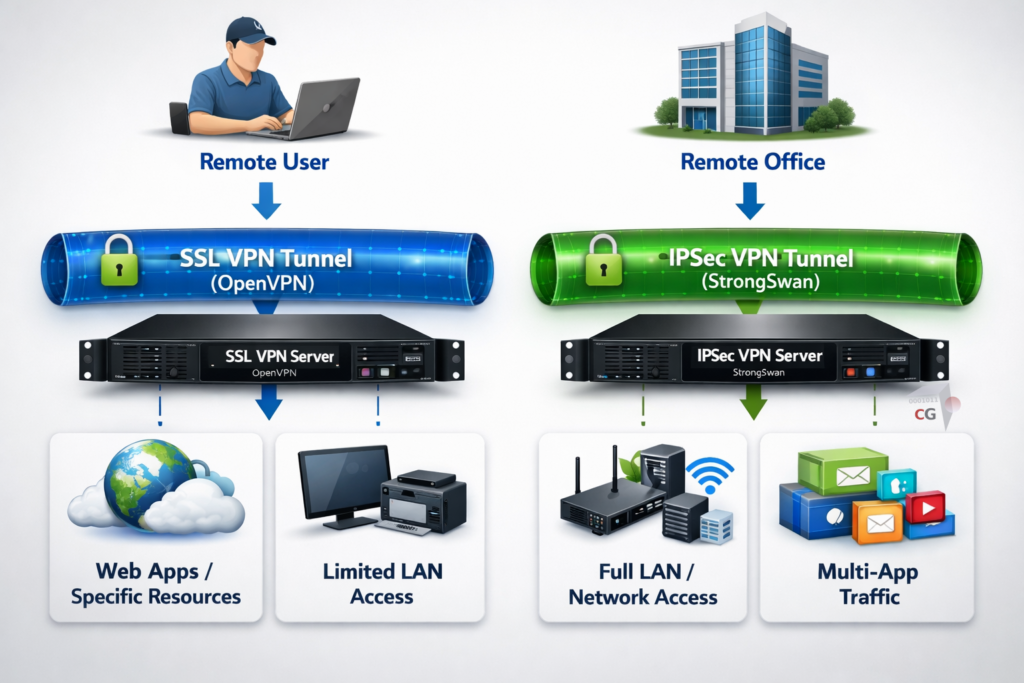
What is an IPsec VPN? (IPsec VPN overview and definition)
An IPsec VPN (Internet Protocol Security VPN) is a protocol suite that secures data at the network layer (Layer 3) of the OSI model.
It encrypts and authenticates IP packets before transmission, ensuring secure communication between networks or endpoints over the internet.
Key characteristics:
- 🛡️ Network-layer security (Layer 3)
- 🔐 Full IP traffic encryption
- 🌍 Commonly used for site-to-site VPN tunnels
- ⚙️ Requires VPN client or gateway configuration
- 🏢 Designed for enterprise network infrastructure
IPsec VPN is widely used as a backbone technology for secure interconnection between corporate networks.
What is an SSL VPN? (SSL VPN remote access explained)
An SSL VPN (Secure Sockets Layer VPN) uses SSL/TLS encryption to secure connections between users and specific applications or services.
Unlike IPsec, SSL VPN operates at the application layer (Layer 7), allowing more granular access control.
Key characteristics:
- 🌐 Application-layer security (Layer 7)
- 🔐 Uses SSL/TLS (HTTPS-based encryption)
- 💻 Often browser-based access
- 🎯 Provides application-level connectivity
- 👨💻 Ideal for remote users and mobile access
SSL VPN is widely used in remote work environments due to its simplicity and flexibility.
IPsec vs SSL VPN: Core Differences Explained
Understanding IPsec vs SSL VPN differences is essential for selecting the right VPN architecture.
IPsec VPN vs SSL VPN: network layer comparison
- IPsec VPN operates at Layer 3 (network layer)
- SSL VPN operates at Layer 7 (application layer)
Full network access vs application access
- 🏢 IPsec VPN provides full network access
- 💼 SSL VPN provides access only to selected applications
VPN client vs browser-based access
- ⚙️ IPsec VPN typically requires a dedicated client or configuration
- 🌐 SSL VPN often works directly through a web browser
Deployment complexity comparison
- IPsec VPN requires more complex configuration and routing
- SSL VPN is easier to deploy for end users
Security model differences
- IPsec VPN secures all network traffic
- SSL VPN secures individual sessions or application connections
IPsec VPN vs SSL VPN performance comparison
Performance differences between IPsec VPN and SSL VPN depend on infrastructure and usage scenarios.
IPsec VPN performance advantages
- 🚀 High throughput for continuous traffic
- 📉 Lower latency due to network-level processing
- 🧭 Ideal for site-to-site VPN connections
SSL VPN performance characteristics
- 🔄 Slight overhead due to TLS encryption
- 🌍 Works well in restricted networks (firewalls, NAT)
- 👥 Optimized for remote user access
In general, IPsec VPN delivers better raw performance, while SSL VPN offers greater flexibility in restrictive environments.
IPsec VPN vs SSL VPN security comparison
Both VPN technologies are secure, but they follow different security approaches.
IPsec VPN security strengths
- 🔐 Strong encryption standards (AES-based implementations)
- 🏢 Mature and widely audited protocol suite
- 🧱 Best for controlled enterprise environments
SSL VPN security strengths
- 🌐 Built on TLS encryption (HTTPS security model)
- 🎯 Enables granular access control per user or application
- 🧾 Easier integration with identity-based authentication
⚠️ Proper configuration is critical, especially for SSL VPN gateways.
IPsec VPN vs SSL VPN use cases (when to use each VPN type)
When to use IPsec VPN
- Site-to-site connectivity between offices
- Full network access is required
- Enterprise-controlled environments
- High-performance VPN tunnels are needed
When to use SSL VPN
- Remote employees accessing internal apps
- Personal or unmanaged devices
- Firewall-restricted environments
- Browser-based access requirements
CacheGuard and IPsec VPN (open-source VPN foundation)
In real-world deployments, many organizations prefer integrated security platforms rather than managing separate VPN solutions.
CacheGuard provides a unified network security and optimization platform that includes firewalling, web filtering, traffic control, and built-in VPN capabilities.
Its IPsec VPN implementation is based on strongSwan, a widely trusted open-source IPsec solution used in many enterprise and carrier-grade environments.
👉 Learn more about strongSwan: https://www.strongswan.org/
By leveraging strongSwan, CacheGuard delivers a robust and standards-compliant IPsec VPN engine while simplifying deployment through its integrated CacheGuard-OS (Linux-based open-source architecture).
👉 Official CacheGuard website: https://www.cacheguard.com/
This approach is particularly useful for organizations that want reliable IPsec VPN functionality without the complexity of managing separate VPN infrastructure.
IPsec vs SSL VPN summary table
| Feature | IPsec VPN | SSL VPN |
|---|---|---|
| OSI layer | Network (Layer 3) | Application (Layer 7) |
| Access type | Full network access | Application-level access |
| Client requirement | Required | Often browser-based |
| Setup complexity | Higher | Lower |
| Performance | High | Moderate |
| Best use case | Site-to-site VPN | Remote access VPN |
Conclusion: IPsec VPN vs SSL VPN which one to choose?
The choice between IPsec vs SSL VPN is not about which technology is better overall, but which one fits the use case.
- 🔐 IPsec VPN is best for secure, high-performance enterprise network connectivity and site-to-site communication
- 🌐 SSL VPN is best for flexible, user-friendly remote access to applications
In modern hybrid infrastructures, organizations often deploy both technologies together to balance performance, security, and usability.
