

If you’ve ever wondered how HTTPS works, you’re not alone. Every time someone visits a website, logs in, or submits sensitive information, HTTPS is what keeps that data secure.

🌍 How HTTPS Works and What HTTPS Is
HTTPS (HyperText Transfer Protocol Secure) is the secure version of HTTP. It protects communication between a browser and a web server using SSL/TLS encryption.
It ensures:
- Encryption of data in transit
- Server authentication
- Data integrity
For the official protocol definition, see the HTTP specification in the RFC series:
👉 https://www.rfc-editor.org/rfc/rfc9110
🔐 How HTTPS Works Step by Step in the TLS Handshake
Understanding how HTTPS works starts with the TLS handshake process:
1. Client Hello in HTTPS Connection Setup
The browser initiates a connection and sends supported encryption methods.
2. Server Hello in Secure HTTPS Communication
The server responds with its SSL/TLS certificate and chosen encryption method.
3. Certificate Validation in HTTPS Security Model
The browser validates the certificate using trusted Certificate Authorities.
4. Key Exchange for HTTPS Encryption
A secure session key is established using asymmetric cryptography.
5. How HTTPS works when establishing encrypted communication
All communication is then encrypted using symmetric encryption for performance.
⭐ Why HTTPS Security Matters for Modern Web Traffic
HTTPS provides:
- Confidentiality (prevents eavesdropping)
- Integrity (prevents tampering)
- Authentication (verifies server identity)
🔁 Reverse Proxy SSL Termination Explained (HTTPS Offloading)
A reverse proxy SSL terminator sits between clients and backend servers. It:
- Accepts HTTPS connections
- Terminates (decrypts) SSL/TLS
- Forwards requests to backend servers
This centralizes encryption handling and reduces backend complexity.
⚙️ How SSL Termination Works in Reverse Proxy Architecture
- Client connects via HTTPS to reverse proxy
- Reverse proxy decrypts HTTPS traffic
- Traffic is forwarded to backend servers (HTTP or HTTPS)
- Backend processes request
- Response is returned through proxy
⚖️ Advantages of SSL Termination in HTTPS Architectures
- Improved performance by offloading encryption
- Centralized certificate management
- Simplified backend infrastructure
- Built-in load balancing
- Advanced traffic routing
⚠️ Disadvantages of SSL Termination in HTTPS Systems
Internal Traffic May Be Unencrypted in Backend Networks
Backend communication may use HTTP, requiring secure network design.
Reverse Proxy Can Become a Single Point of Failure
A single proxy can become a critical dependency.
Security Responsibility Shifts to Proxy Layer
The reverse proxy becomes a critical security component.
🚀 CacheGuard Reverse Proxy for HTTPS Termination and Load Balancing
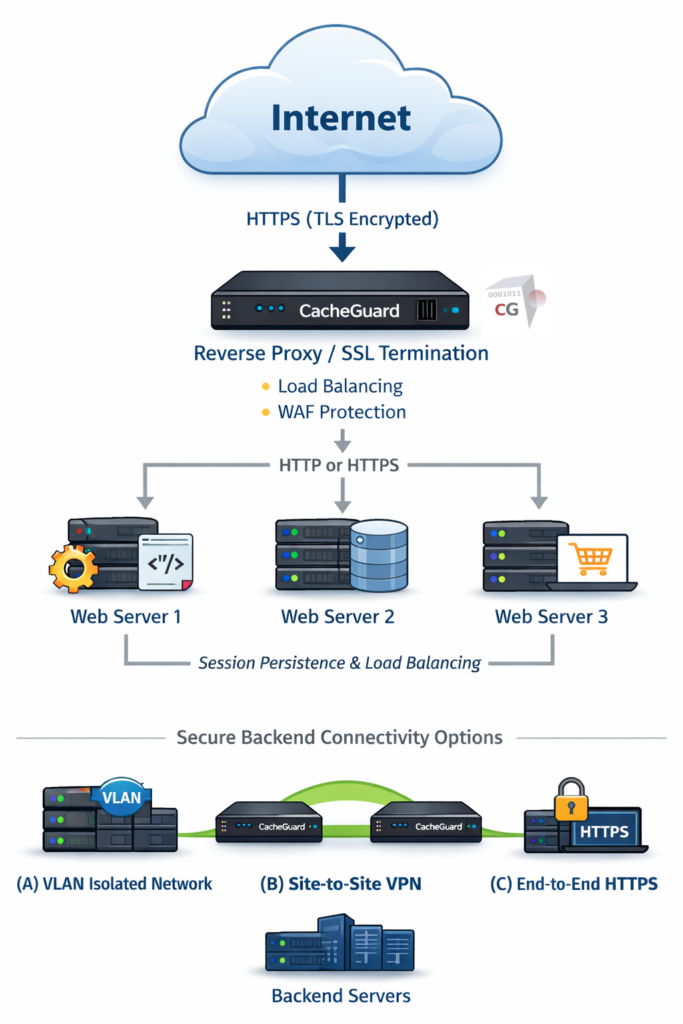
CacheGuard is a reverse proxy solution that provides SSL termination, load balancing, and integrated security features.
Flexible Backend Communication After HTTPS Termination
After SSL termination, CacheGuard can forward traffic using:
- HTTP over a dedicated VLAN
- Site-to-site VPN between CacheGuard appliances
- HTTPS for end-to-end encryption
🔄 How HTTPS works with session persistence in load balancing
CacheGuard supports intelligent load balancing with session persistence in HTTPS environments.
It ensures users stay routed to the same backend server using session cookies, which is essential for:
- Authentication systems
- E-commerce platforms
- Stateful applications
🧱 How HTTPS works with a built-in Web Application Firewall (WAF)
CacheGuard includes an embedded WAF that protects against:
- SQL injection
- Cross-site scripting (XSS)
- Bot attacks
- Application-layer threats
Because it operates after HTTPS termination, it can inspect decrypted traffic in real time.
🛡️ How HTTPS works in High Availability (HA) reverse proxy deployments
To avoid SPOF, CacheGuard supports High Availability (HA) deployment.
You can deploy two or more CacheGuard gateway appliances in HA mode, ensuring:
- Automatic failover
- Continuous HTTPS service availability
- Infrastructure resilience
🧠 Conclusion: Understanding How HTTPS Works in Modern Reverse Proxy Architectures
Understanding how HTTPS works is fundamental to modern web security. In production environments, HTTPS is often terminated at the reverse proxy layer rather than directly on backend servers.
CacheGuard enhances this architecture by combining:
- SSL termination for HTTPS traffic
- Load balancing with session persistence
- Flexible backend communication
- Integrated WAF protection
- High Availability (HA) for reverse proxy resilience
👉 Learn more about CacheGuard here: https://www.cacheguard.com/
