
Sophos Alternative: Why CacheGuard Is a Smarter Choice for Growing Businesses
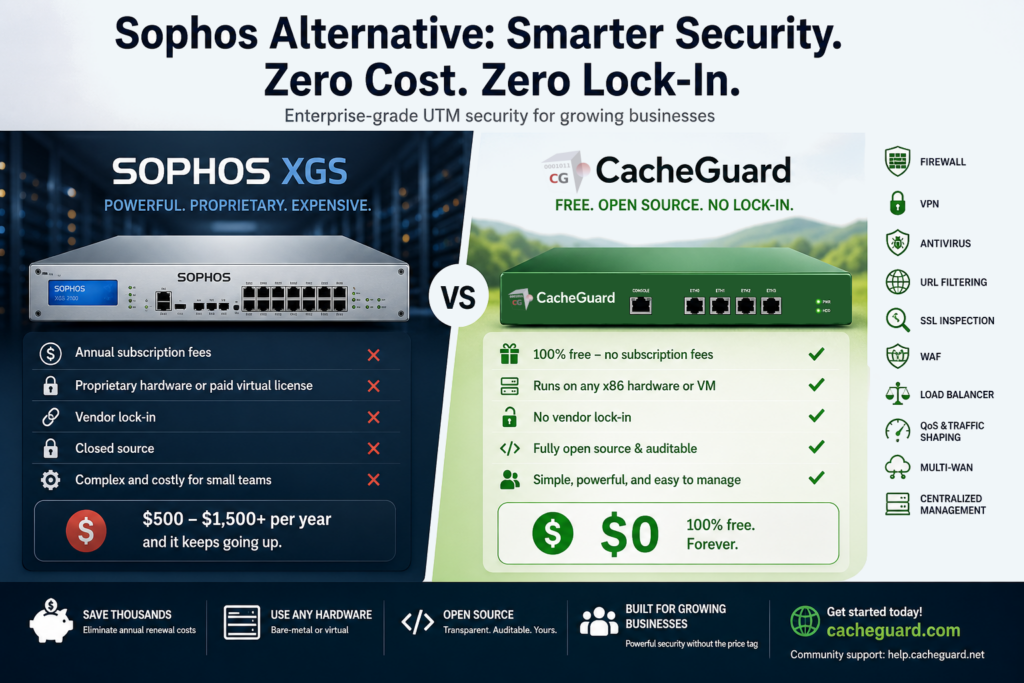
If you are looking for a Sophos alternative, cost is probably the first reason. Sophos XG and XGS Series appliances are genuinely capable security products — but they come with proprietary hardware requirements, annual subscription fees, and a renewal cycle that adds up quickly for small and medium businesses.
This article explains what Sophos offers, where it falls short for budget-conscious organizations, and why CacheGuard is worth considering as a free, open-source Sophos alternative that covers most of the same ground without the ongoing cost.
What Is Sophos XG and Who Is It For?
Sophos XG — now the XGS Series — is a commercial Unified Threat Management appliance produced by Sophos, a well-established cybersecurity vendor. It combines firewall, VPN, web filtering, antivirus, intrusion prevention, WAF and traffic management into a single platform, making it conceptually similar to CacheGuard in its all-in-one approach.
Sophos XGS is genuinely feature-rich. It includes advanced capabilities like deep learning threat detection, cloud sandboxing for zero-day malware analysis, Security Heartbeat (which links firewall and endpoint protection), and email security. These are enterprise-grade features designed for organizations with complex security requirements and dedicated IT security teams.
The XGS Series is available as dedicated hardware appliances or as a virtual/software deployment — but either way, it requires annual subscription licensing to access security features, firmware updates and support.
Why Organizations Look for a Sophos Alternative
Despite its capabilities, Sophos XG is not the right fit for every organization. Here are the most common reasons businesses start looking for a Sophos alternative:
Subscription costs add up fast. Sophos requires annual license renewals to maintain access to security features and firmware updates. A basic 3-year license for a small model can run $1,500 or more, and larger deployments scale significantly higher. For a startup or small business operating on a tight budget, that is a substantial recurring cost.
Proprietary hardware dependency. The XGS Series is designed around Sophos proprietary hardware appliances. If you want to run it on your own commodity servers or virtual machines, you still need to purchase a virtual license — there is no free option for running it on infrastructure you already own.
Vendor lock-in. When you build your network security around Sophos, you are committing to their hardware, their licensing model, and their renewal cycle. If you stop paying, you lose access to updates and eventually to security features entirely. That dependency is a strategic risk for smaller organizations.
Closed source. Sophos XG is completely proprietary software. You cannot audit the code, customize its behavior, or verify what it does at a low level. For organizations that value transparency and software sovereignty, this is a real concern.
Complexity for non-specialist teams. While Sophos has invested in usability, it remains a complex product with many interdependent modules, licensing tiers and configuration options. For small teams without a dedicated security engineer, the learning curve can be steep.
CacheGuard as a Sophos Alternative: The Case for Free and Open Source
CacheGuard is a free, open-source network security appliance that covers most of what Sophos XG offers for small and medium businesses — at zero cost, on any hardware, with no subscription fees and no vendor lock-in.
A free Sophos alternative with no subscription fees
CacheGuard-OS is completely free to use regardless of the number of users, the number of appliances you deploy, or how long you use it. There are no licensing tiers, no annual renewals, and no features locked behind a paywall. Optional paid support plans are available for organizations that need guaranteed response times — but the software itself is always free.
For a startup or small business that would otherwise be paying $500 to $1,500 per year for a Sophos license, that represents immediate and permanent cost savings.
Run it on any hardware or VM
Unlike Sophos, which ties you to proprietary hardware or a paid virtual license, CacheGuard runs on any standard x86 bare-metal machine or virtual machine — including hardware you already own. VMware, VirtualBox, Proxmox, KVM, Hyper-V, AWS, Azure — CacheGuard works on all of them at no additional cost.
Fully open source and auditable
CacheGuard-OS is completely open source, with the full source code available on GitHub. Every component can be inspected, audited and verified. For organizations that value software sovereignty and transparency — particularly in a security context — this is a significant advantage over a closed, proprietary product like Sophos.
Everything included out of the box
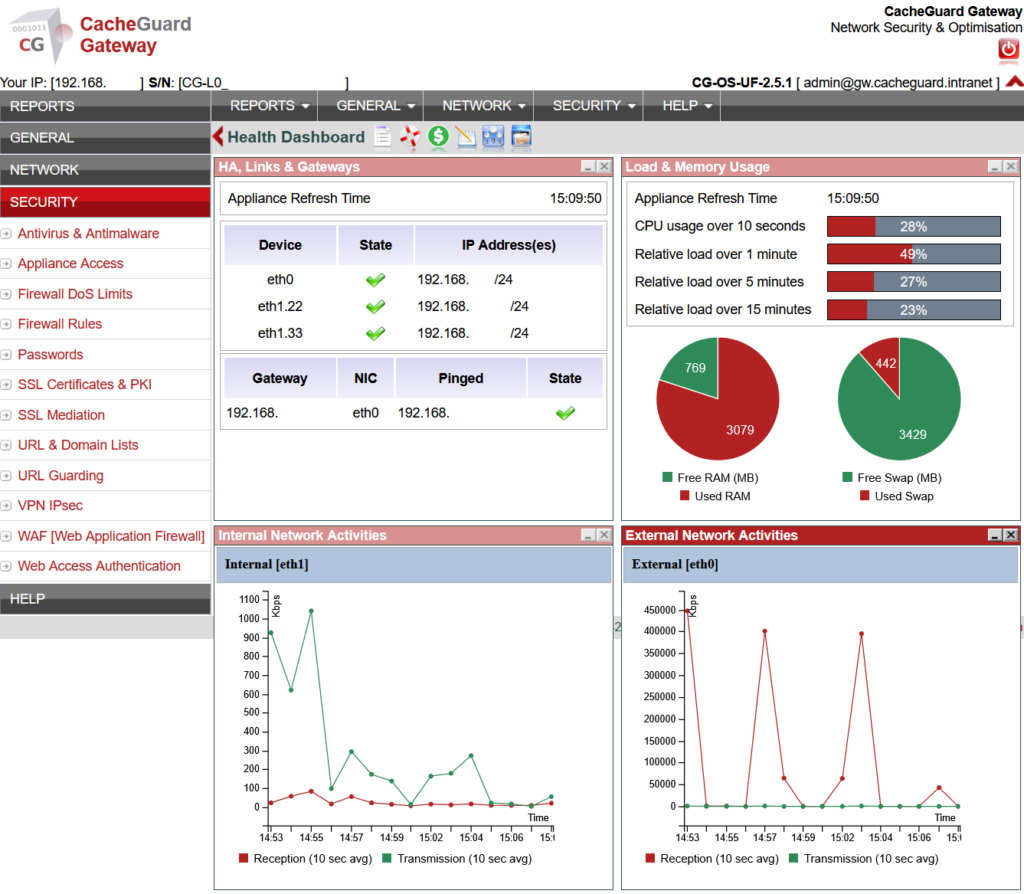
Like Sophos, CacheGuard takes an all-in-one approach. Everything is built in and works together from day one:
- Stateful firewall with fine-grained traffic control
- IPsec VPN for secure remote access and site-to-site connectivity
- Gateway-level web antivirus powered by ClamAV
- URL filtering to block malicious and unwanted websites
- SSL inspection to detect threats hidden in encrypted HTTPS traffic
- Web Application Firewall to protect your web applications from attacks
- Reverse proxy and application load balancer
- Multi-WAN support with automatic failover and load balancing
- QoS and traffic shaping to prioritize critical applications
- Web caching to reduce bandwidth usage and speed up browsing
- Centralized management via CacheGuard Manager for multi-site deployments
No plugins, no subscription modules, no separate licenses for individual features.
Sophos XG vs CacheGuard: Feature Comparison
| Feature | Sophos XGS | CacheGuard |
|---|---|---|
| Firewall | ✅ Advanced | ✅ Standard, suitable for most deployments |
| IPsec VPN | ✅ | ✅ |
| SSL VPN | ✅ | ❌ IPsec only |
| Web antivirus | ✅ | ✅ |
| URL filtering | ✅ | ✅ Built-in, LDAP/AD |
| SSL inspection | ✅ | ✅ |
| WAF | ✅ | ✅ |
| Reverse proxy | ✅ | ✅ |
| Load balancer | ✅ | ✅ |
| Web caching | ✅ | ✅ |
| Multi-WAN and QoS | ✅ | ✅ |
| Centralized management | ✅ Sophos Central | ✅ CacheGuard Manager |
| Email protection | ✅ | ❌ |
| Deep learning / AI threat detection | ✅ | ❌ |
| Cloud sandboxing | ✅ | ❌ |
| Endpoint-firewall synchronization | ✅ Security Heartbeat | ❌ |
| Hardware flexibility | ❌ Proprietary or paid virtual | ✅ Any x86 hardware or VM |
| Open source | ❌ | ✅ |
| Cost | Paid + annual subscription | Free |
| Vendor lock-in | Yes | No |
Who Should Choose CacheGuard as Their Sophos Alternative
CacheGuard is the right Sophos alternative for:
Startups and growing businesses that need comprehensive network security but cannot justify the ongoing cost of a Sophos subscription. CacheGuard delivers the same core UTM features — firewall, VPN, antivirus, WAF, URL filtering, SSL inspection — for free.
Budget-conscious organizations that want to avoid annual renewal cycles and vendor lock-in. CacheGuard runs on commodity hardware you already own with no licensing fees ever.
Organizations that value open source. If being able to audit and verify your security software matters to you, CacheGuard’s fully open codebase on GitHub is a major advantage over Sophos’s closed proprietary system.
MSPs and IT consultants who need a cost-effective, repeatable security solution they can deploy quickly for multiple clients without per-device or per-user licensing costs.
Schools and institutions that need solid network security and content filtering on limited budgets — exactly the scenario where Sophos subscription costs become prohibitive.
Who Should Stick With Sophos
CacheGuard is not the right choice for every organization. Sophos XGS remains the better option for:
- Organizations that need advanced threat detection powered by deep learning and AI
- Environments requiring cloud sandboxing for zero-day malware analysis
- Businesses that use Sophos endpoint protection and want Security Heartbeat integration
- Deployments requiring built-in email security and anti-spam
- Large enterprises that need vendor-backed SLAs and 24/7 enterprise support
How to Get Started With CacheGuard
Switching to CacheGuard as your Sophos alternative is straightforward:
- Download the free CacheGuard-OS ISO from cacheguard.com
- Install on any x86 bare-metal machine or VM with at least two network interfaces
- Access the web interface and configure your basic network settings
- Enable security features progressively — firewall, VPN, antivirus, WAF
- Your network is protected in under an hour — at zero cost
The full source code is available on GitHub and the documentation covers every step of the installation and configuration process in detail.
Conclusion
If you are looking for a Sophos alternative that delivers comprehensive UTM security without the subscription fees, proprietary hardware requirements and vendor lock-in, CacheGuard is a compelling choice.
It does not replicate every advanced feature that Sophos offers — deep learning threat detection, sandboxing and email security remain Sophos strengths. But for the vast majority of startups, small businesses and growing organizations, CacheGuard covers every security need that matters — firewall, VPN, antivirus, WAF, URL filtering, SSL inspection and more — completely free, on any hardware, forever.
Download CacheGuard for free and see how much you can save without compromising on security.
Questions about deploying CacheGuard? Visit the community forum at help.cacheguard.net or browse the full documentation at cacheguard.com.