

This article explores pfSense vs CacheGuard, highlighting the key benefits and features of each solution. When it comes to network security, organizations of all sizes face a critical choice: should they prioritize flexibility and granular control, or should they lean toward integrated functionality and ease of management?
Two of the most popular open-source solutions addressing these needs are pfSense 🛡️ and CacheGuard 🔒. Both are freely available, with optional commercial support, and each provides robust protection for networks and servers. However, they are designed for slightly different users and use cases, meaning their strengths can complement each other when deployed together. That’s why comparing pfSense vs CacheGuard can help you choose the right solution for your requirements.
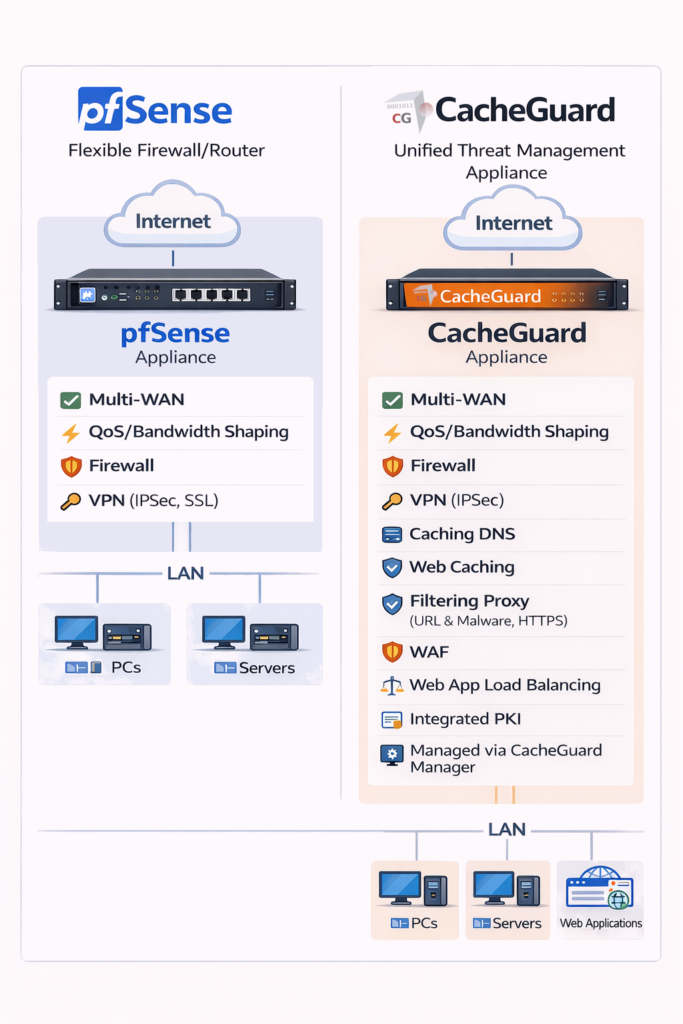
This comparison focuses specifically on pfSense vs CacheGuard, not broader alternatives.
pfSense vs CacheGuard – Understanding the Solutions
pfSense 🛡️: Power and Flexibility
pfSense is a highly flexible firewall and routing platform built on FreeBSD, a Unix-like operating system known for its stability and security. This platform is designed for users who require detailed, fine-grained control over every aspect of their network infrastructure.
Some of pfSense’s standout capabilities include:
- Advanced Routing and Multi-WAN Options: pfSense supports complex routing configurations and multiple WAN connections, allowing organizations to optimize bandwidth and create highly reliable network architectures.
- VPN Support: It supports a variety of VPN technologies, including IPSec and SSL, making it ideal for secure site-to-site connections or remote access.
- Bandwidth Shaping and Quality of Service (QoS): Administrators can prioritize critical traffic, such as VoIP calls or business-critical applications, ensuring smooth operations even under heavy network load.
- Network-Layer Security: With a strong focus on firewalling and routing, pfSense offers robust protection for servers and network infrastructure while allowing customization to suit complex enterprise needs.
In short, pfSense is best suited for organizations with IT teams that have strong networking expertise and require full control over their infrastructure.
CacheGuard 🔒: Integrated Security and Simplicity
By contrast, CacheGuard is a Unified Threat Management (UTM) appliance designed to combine multiple security functions into a single, integrated solution. While pfSense focuses on network flexibility, CacheGuard emphasizes ease of use and comprehensive web application protection.
Key features of CacheGuard include:
- Web Application Protection: CacheGuard provides a built-in Web Application Firewall (WAF) and actively blocks malware in web traffic, helping safeguard business-critical web applications.
- Caching and Reverse Proxy: Improves web performance while maintaining security.
- Web Filtering and Antivirus: Integrated tools ensure malicious content is blocked before reaching end users.
- VPN and Multi-WAN Support: Supports IPSec VPN for both site-to-site and remote connections, with fully integrated load balancing and failover capabilities.
- Network-Layer Security: To defend against DoS attacks, IP spoofing, and unauthorized access.
- Centralized Management: The CacheGuard Manager allows administrators to manage multiple appliances from a single dashboard, ideal for organizations with multiple branch offices.
CacheGuard is particularly useful for small-to-medium businesses, educational institutions, and branch offices, or any scenario where IT resources may be limited. Its appliance-style design and user-friendly interface make it approachable for non-specialist IT teams while still providing comprehensive UTM capabilities.
pfSense vs CacheGuard – Comparing Key Features
To better understand the differences between pfSense and CacheGuard, here’s a side-by-side comparison:
| Feature | pfSense 🛡️ | CacheGuard 🔒 |
|---|---|---|
| Firewall & Routing 🔥 | Advanced routing, network segmentation, highly configurable | Standard routing suitable for most SMB and branch deployments |
| Multi-WAN Support 🌐 | Multiple WAN connections with failover | WAN failover plus integrated load balancing for simplified management |
| VPN Capabilities 🔑 | Supports multiple protocols; highly customizable | IPSec VPN for site-to-site and remote; fully integrated |
| Server & Web Security 🖥️ | Network-layer server protection | Network-layer + WAF, malware blocking, and web application security |
| Web Proxy & Filtering 🌐🛡️ | Available via packages like Squid | Natively integrated and easy to deploy |
| Antivirus & Malware Protection 🦠 | Optional through packages | Built specifically for web-based malware interception |
| Centralized Management 🗂️ | Not included | Included via CacheGuard Manager |
The comparison highlights a fundamental trade-off: pfSense offers unmatched flexibility, while CacheGuard offers a ready-to-use, integrated security solution.
Typical Use Cases
pfSense 🛡️ shines in environments that demand network-level control and flexibility, such as:
- Enterprise firewalls with complex routing and segmentation requirements.
- Data center edge security for high-performance networks.
- VPN hubs connecting multiple sites.
- Secure server access requiring detailed configuration.
It is best suited for IT teams that have deep networking knowledge and want full control over routing, firewall, and traffic management.
CacheGuard 🔒, on the other hand, is ideal for environments that need integrated web application security and simplified management, including:
- Small-to-medium businesses and branch offices.
- Schools and educational institutions.
- Organizations with limited IT resources.
Its combination of caching, web filtering, WAF, malware protection, VPN, Multi-WAN, and centralized management simplifies operations without compromising security.
Deployment Strategies: Using Both Together
In many scenarios, organizations choose to deploy pfSense and CacheGuard together to leverage the strengths of both platforms.
A common deployment topology looks like this:
Internet 🌐
   |
pfSense 🛡️ (edge firewall / routing)
   |
CacheGuard 🔒 (web application protection + caching + WAF + VPN)
   |
LAN / Servers 🖥️
- pfSense handles complex network traffic, segmentation, and routing, providing unmatched control at the edge.
- CacheGuard sits behind pfSense to manage web application security, caching, content filtering, and VPN connections, simplifying day-to-day administration.
This setup provides a balanced approach: organizations gain the flexibility of pfSense while benefiting from the integrated security features of CacheGuard.
pfSense vs CacheGuard Key Takeaways
- pfSense 🛡️: Ideal for network specialists seeking granular control and advanced routing, firewall, VPN, and traffic management capabilities.
- CacheGuard 🔒: Perfect for non-specialist teams requiring a full UTM solution, integrated web security, and centralized management.
- Combined Deployment: Using both platforms together allows organizations to achieve flexibility plus integrated security, covering both network-level and web application-level protection.
Learn More
Explore these platforms further via their official websites:
- pfSense 🛡️ Official Website – Access downloads, documentation, and community support for this flexible open-source firewall and routing platform.
- CacheGuard 🔒 Official Website – Learn about features, demos, support options, and centralized UTM management for secure web applications and VPN deployment.
- pfSense 🧩 Alternatives – If you have already decided to switch from pfSense, read our dedicated pfSense alternative article.
