
OPNsense Alternative: Why CacheGuard Is the Easier Choice for Small Businesses
If you are looking for an OPNsense alternative, you are probably already familiar with the limitations that come with OPNsense — the steep learning curve, the time required to configure it properly, and the need to install multiple plugins just to reach a feature-complete security setup.
OPNsense is a powerful and respected open-source firewall. But powerful does not always mean practical, especially for startups and small businesses that do not have a dedicated network security team. This article explores why CacheGuard is the most compelling OPNsense alternative for organizations that need comprehensive protection without the complexity.
What Is OPNsense and Who Is It For?
OPNsense is a free, open-source firewall and routing platform based on FreeBSD. It offers a wide range of features including stateful packet filtering, VPN support, traffic shaping and intrusion detection. It is highly configurable and has a large and active community.
However OPNsense is primarily designed for users with strong networking expertise. Getting the most out of it requires significant time investment — configuring plugins, understanding FreeBSD networking concepts, and maintaining the system as it evolves. For organizations with experienced IT teams, that flexibility is a genuine strength. For everyone else, it can be a barrier.
Why Organizations Look for an OPNsense Alternative
There are several common reasons why startups and small businesses start looking for an OPNsense alternative:
Complexity. OPNsense requires a solid understanding of networking concepts to configure correctly. Features like web antivirus, WAF and SSL inspection require additional plugins and manual setup. For a small team without a dedicated sysadmin, this quickly becomes a time sink.
Plugin dependency. Out of the box, OPNsense is primarily a firewall and router. To build a full UTM stack you need to install and configure multiple third-party plugins, each with its own settings, update cycle and potential compatibility issues.
Time to deploy. Setting up OPNsense to a production-ready state with full security features enabled can take days for non-specialists. For a startup that needs to be protected quickly, that is time that could be spent building the product.
Maintenance overhead. Keeping multiple plugins updated and compatible with each other adds ongoing maintenance work that many small teams cannot afford.
CacheGuard as an OPNsense Alternative: What Makes It Different
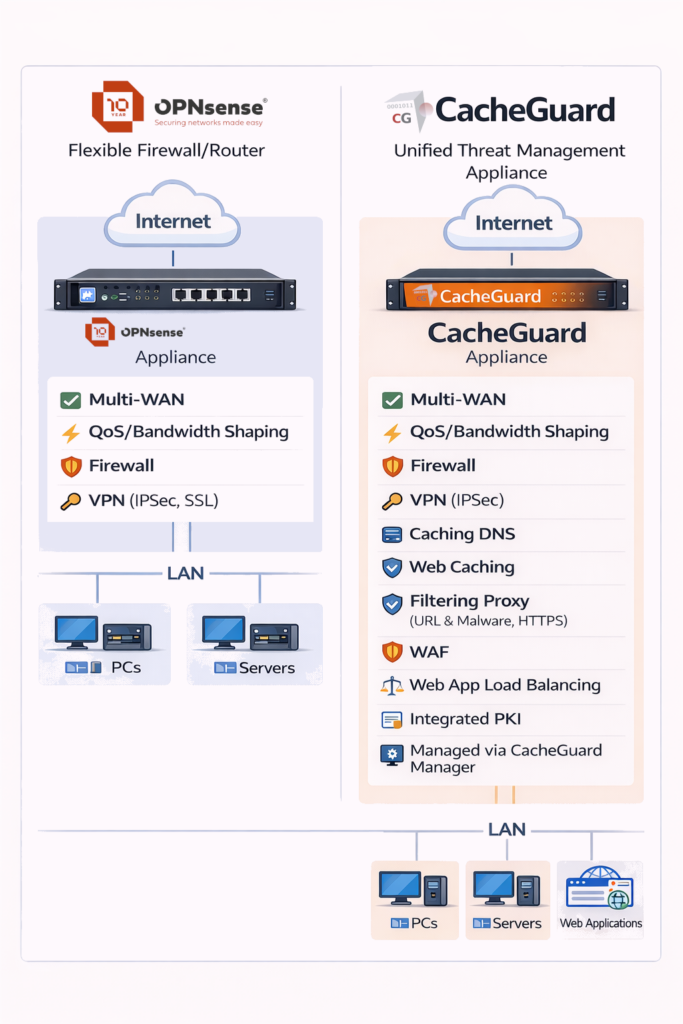
CacheGuard is a free, open-source network security appliance that takes a fundamentally different approach to the same problem. Rather than offering a flexible platform you build on top of, CacheGuard delivers a complete, integrated security stack in a single ISO — ready to deploy in under an hour.
A true all-in-one OPNsense alternative
Where OPNsense requires plugins to reach feature parity, CacheGuard includes everything out of the box:
- Stateful firewall with fine-grained traffic control
- IPsec VPN for secure remote access and site-to-site connectivity
- Web antivirus — gateway-level malware scanning powered by ClamAV
- URL filtering — block malicious or unwanted websites
- SSL inspection — inspect encrypted HTTPS traffic for hidden threats
- Web Application Firewall — protect your web applications from attacks
- Reverse proxy and load balancer
- Multi-WAN support with failover and load balancing
- QoS and traffic shaping
- Web caching to reduce bandwidth and improve performance
- Centralized management via CacheGuard Manager for multi-site deployments
No plugins, no compatibility issues, no surprises. Everything is designed to work together from day one because it was built that way from the ground up.
Built as an OS, not an app
CacheGuard-OS is not an application you install on top of an existing operating system. It IS the operating system — a fully custom, network appliance oriented OS built from scratch over more than 20 years of development, now fully open source on GitHub.
This approach means CacheGuard is leaner, more focused and more secure than a general purpose OS running security software on top. Every component is selected and integrated deliberately, with no unnecessary packages or services that could introduce vulnerabilities.
Easier to deploy and manage
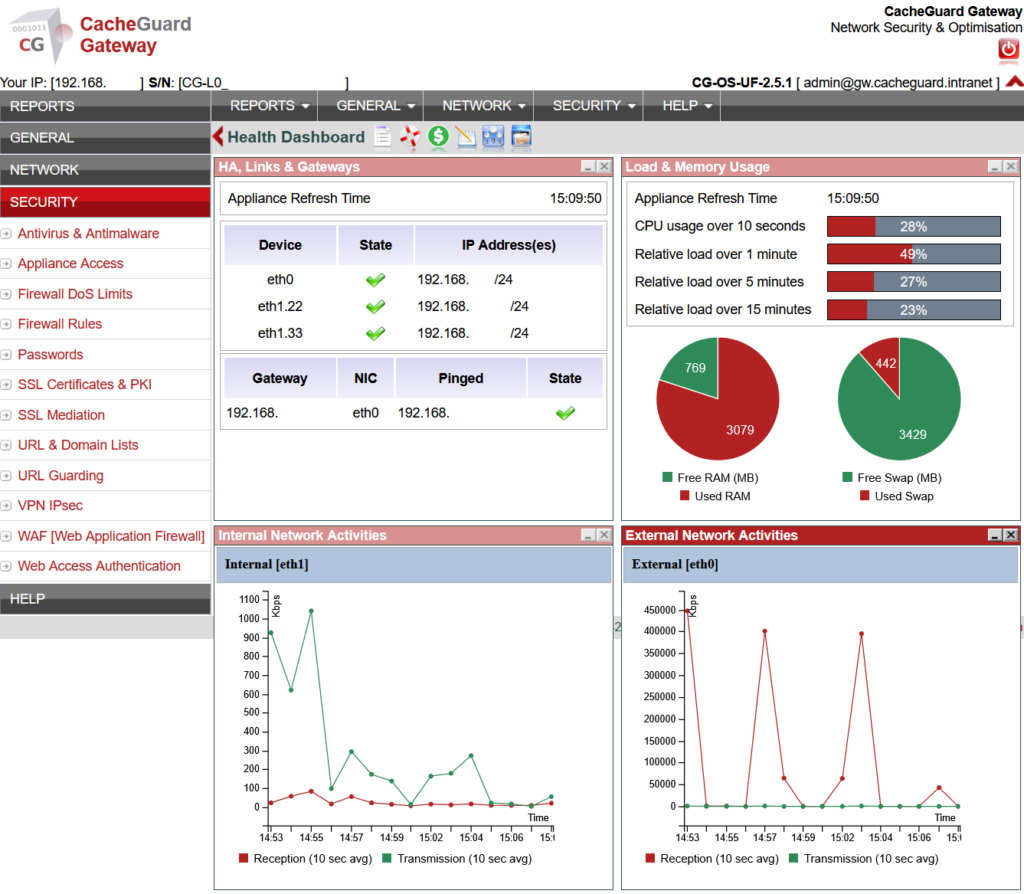
CacheGuard is designed to be set up by anyone with basic networking knowledge. Install the ISO on any x86 bare-metal machine or virtual machine, configure your network interfaces, and your appliance is ready. The web interface is clear and straightforward, and the documentation covers every feature in detail.
For organizations without a dedicated security team, this ease of management is the single most important advantage CacheGuard has over OPNsense as an alternative.
OPNsense vs CacheGuard: Feature Comparison
| Feature | OPNsense | CacheGuard |
|---|---|---|
| Firewall | ✅ Advanced | ✅ Standard, suitable for most deployments |
| IPsec VPN | ✅ | ✅ |
| SSL VPN | ✅ | ❌ IPsec only |
| Web antivirus | ⚠️ Plugin required | ✅ Built-in |
| URL filtering | ⚠️ Plugin required | ✅ Built-in, LDAP/AD |
| SSL inspection | ⚠️ Plugin required | ✅ Built-in |
| WAF | ⚠️ Plugin required | ✅ Built-in |
| Reverse proxy | ⚠️ Plugin required | ✅ Built-in |
| Load balancer | ⚠️ Plugin required | ✅ Built-in |
| Web caching | ⚠️ Plugin required | ✅ Built-in |
| Multi-WAN / QoS | ✅ | ✅ |
| Centralized management | ❌ | ✅ CacheGuard Manager |
| Setup time | Several hours to days | Under an hour |
| Base OS | FreeBSD | Custom Linux from scratch |
| Cost | Free | Free |
| Open source | ✅ | ✅ |
Who Should Choose CacheGuard as Their OPNsense Alternative
CacheGuard is the right OPNsense alternative for:
Startups setting up their network security for the first time and needing to be protected quickly without a steep learning curve.
Small and medium businesses that need comprehensive UTM protection but do not have a full time network security engineer on staff.
Schools and institutions looking for content filtering, web antivirus and network security without operational complexity.
MSPs and IT consultants who need a repeatable, easy to deploy solution they can roll out quickly for multiple clients.
Multi-site organizations that need centralized management of multiple security appliances from a single dashboard.
Who Should Stick With OPNsense
CacheGuard is not the right choice for every organization. OPNsense remains the better option for:
- Organizations with experienced networking teams that need fine-grained control over every aspect of their firewall configuration
- Environments requiring advanced routing features and complex network segmentation
- Deployments where SSL VPN is a hard requirement
- IT professionals who enjoy the flexibility of a plugin-based ecosystem and are comfortable maintaining it
How to Get Started With CacheGuard
Getting started with CacheGuard as your OPNsense alternative is straightforward:
- Download the free CacheGuard-OS ISO from cacheguard.com
- Install it on any x86 bare-metal machine or virtual machine with at least two network interfaces
- Access the web interface and configure your network settings
- Enable the security features you need — firewall, VPN, antivirus, WAF — progressively through the interface
- Your network is protected in under an hour
The full source code is available on GitHub and the documentation covers every step of the installation and configuration process.
Conclusion
If you are looking for an OPNsense alternative that delivers more security features out of the box, is easier to deploy and manage, and costs nothing, CacheGuard is the answer.
It does not try to compete with OPNsense on raw configurability. Instead it focuses on what most startups and small businesses actually need — comprehensive, production-ready network security that works from day one without requiring weeks of configuration and ongoing plugin maintenance.
Download CacheGuard for free at cacheguard.com and have your network secured in under an hour.
Questions about deploying CacheGuard? Visit the community forum at help.cacheguard.net or explore the full documentation at CacheGuard Documentation.